Most “rock musician” prompts floating around the internet produce the same result: a guy in a leather jacket, a spotlight, and skin so smooth it looks shrink-wrapped. You’ve probably tried a few. If you’re a musician who wants promo shots, cover art, or a stage persona that doesn’t scream “AI generated,” the prompt itself has to do more work than “rockstar on stage, dramatic lighting.”
Here’s the thing — a good rock prompt is really a photography brief wearing a costume. Below you’ll find 18 ready-to-use prompts organized by scene, plus the formula behind them, a modifier word bank, negative prompts to clean up common glitches, and a quick breakdown of which AI tool handles which job best.
The Rock Prompt Formula
Before the prompt list, it helps to know the pattern all of them share. Strip away the flavor text and every prompt below follows the same seven-part structure:
Character + Pose + Lens + Lighting + Environment + Imperfection + Color GradeMiss the “imperfection” piece and you’ll get that flat, over-smoothed AI look every time. Miss the lens and lighting pieces and the image has no depth to it at all. Keep this formula in your back pocket and you can build new rock prompts on the fly without copying anyone.
Live Performance & Stage Prompts
Live-stage prompts fall apart for one reason: people describe the mood and skip the mechanics. Anchor each shot in a real photography setup instead.
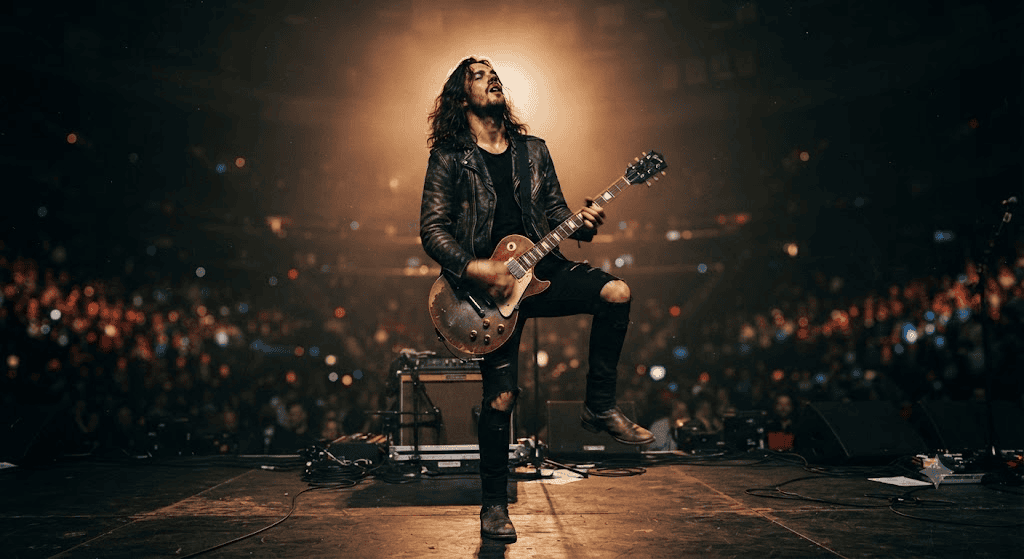
Full-Body Stage Shot
Rock Musician Prompt — Full Body Stage
Full-body shot of a rock guitarist mid-strum on a dim arena stage, one knee bent, head tilted back. Backlit by a single amber spotlight with visible haze, crowd reduced to soft bokeh in the background. Shot on an 85mm f/1.4 lens, shallow depth of field, natural skin texture, slight motion blur on the strumming hand, film-grain finish.
Guitar Solo Close-Up
Rock Musician Prompt — Guitar Solo
Close-up guitar solo shot, musician’s hands captured mid-strum on the fretboard, sweat visible on the forehead, blurred stage lights behind. 100mm macro lens, shallow depth of field, warm spotlight, fine detail on strings and calluses, slight motion blur on the fingers, natural film grain.
Drummer Mid-Hit
Rock Musician Prompt — Drummer
Rock drummer mid-hit behind a full kit, drumsticks blurred in motion, cymbals catching a flash of light, sweat on the arms, stage smoke rising behind the kit. 50mm lens, high-shutter freeze on the face, dynamic low angle, natural skin texture, high-contrast stage lighting.
Bassist in the Pocket
Rock Musician Prompt — Bassist
Bassist locked into a groove, head down, fingers on the fretboard, deep blue stage wash lighting, subtle rim light along the bass body. 35mm lens, slight film grain, candid unposed expression, cables and pedal board visible at the feet.
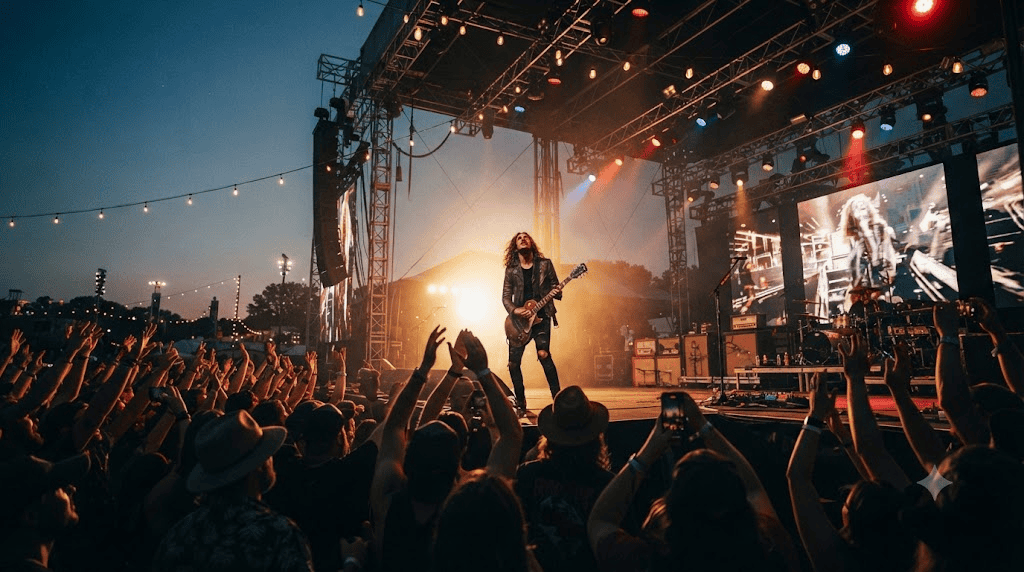
Festival Stage at Dusk
Rock Musician Prompt — Festival Stage
Wide shot of a rock musician performing on an outdoor festival stage at dusk, string lights and stage rig visible above, crowd silhouettes with raised hands in the foreground. 24mm wide lens, golden-hour backlight mixing with stage spotlights, warm color grade, light lens flare.
Rain-Soaked Concert
Rock Musician Prompt — Rain Concert
Rock vocalist performing in the rain, water droplets visible on the microphone and jacket, single cold spotlight cutting through the rainfall, wet stage reflecting light. 85mm lens, shallow depth of field, gritty but dramatic tone, no umbrella or protective gear in frame.
Neon Club Set
Rock Musician Prompt — Neon Club
Musician performing in a small neon-lit club, pink and blue neon signage reflected on sweat-damp skin, tight framing, thin haze in the air. 50mm f/1.4, low-light grain, candid mid-performance expression, analog color grade.
Smoke Machine Entrance
Rock Musician Prompt — Smoke Machine
Rock guitarist emerging through thick stage smoke, single top-down spotlight, smoke swirling around the legs and guitar body, high-contrast shadows. 85mm lens, slow shutter blur on the smoke only, sharp focus on the face.
Vocalist & Frontperson Prompts
Frontperson shots live or die on expression and lighting contrast. These two work for very different rock identities.
Female Rock Singer
Rock Musician Prompt — Female Rock Singer
Female rock vocalist gripping a vintage chrome microphone, leather jacket, wind-blown hair, intense stage lighting from below. 85mm f/1.4, natural skin texture, sweat sheen, no over-smoothed retouching, editorial concert photography.
Punk Vocalist Mid-Scream
Rock Musician Prompt — Punk Vocalist
Punk vocalist mid-scream into a handheld mic, harsh direct flash lighting, safety pins and torn fabric on the jacket, gritty chain-link fence background. 35mm lens, high-contrast black shadows, raw unpolished flash-photography look.
Backstage & Studio Prompts
Everyone prompts the stage shot. Almost nobody prompts the quiet moments around it — and quiet photos often read as more real than anything with pyrotechnics.
Backstage Candid
Rock Musician Prompt — Backstage Candid
Candid backstage portrait, musician sitting at a cluttered dressing-room table, warm tungsten bulbs around a mirror, guitar case open on the floor, adjusting a ring or bracelet, unfocused gaze. 50mm f/1.8, soft shadows, documentary-style framing, no posed smile.
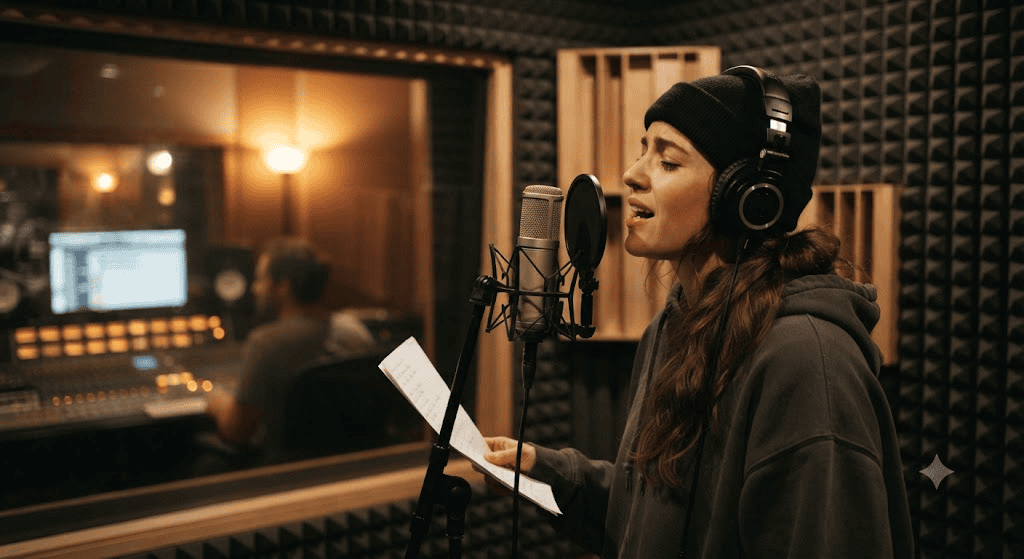
Studio Recording Session
Rock Musician Prompt — Studio Recording
Musician recording vocals in a studio booth, foam-paneled walls, warm control-room lighting glowing through the glass, headphones on, eyes closed mid-take. 50mm lens, shallow depth of field, natural indoor tungsten color balance.
Garage Rehearsal
Rock Musician Prompt — Garage Rehearsal
Band rehearsing in a cluttered home garage, exposed wiring and cheap amps, single bare bulb overhead, dusty light beams cutting through the room. 24mm wide lens, documentary framing, unpolished authentic feel, no stage production.
Acoustic Set
Rock Musician Prompt — Acoustic Rock
Acoustic rock performer seated on a stool under a single warm spotlight, guitar resting on the knee, intimate small-venue setting. 50mm f/1.8, soft bokeh background, natural candid expression, minimal stage design.
Album Cover & Portrait Prompts
Album art prompts tend to overload on adjectives instead of composition. What actually helps is leaving negative space for text, the way real album covers get designed.
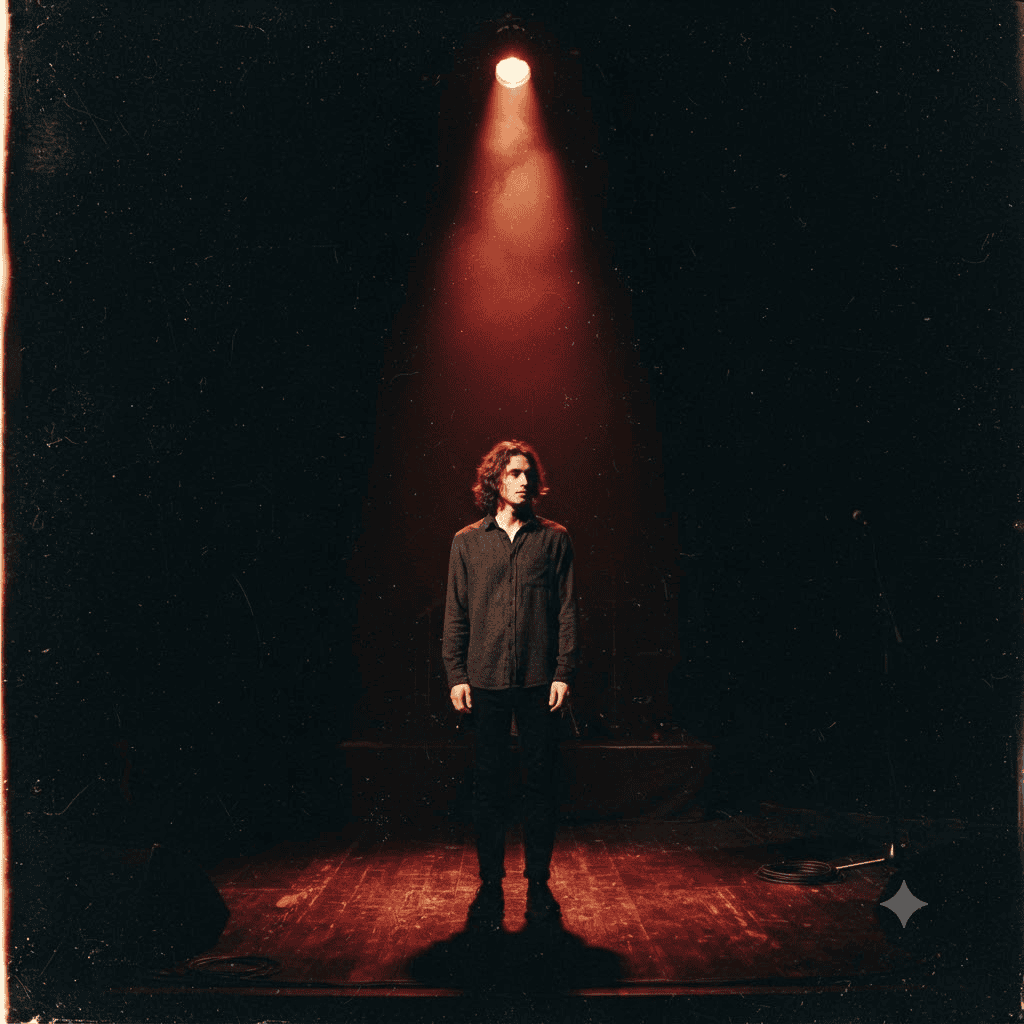
Album Cover Composition
Rock Musician Prompt — Album Cover
Square album cover composition, lone figure standing under a single stage light, deep red and amber color grade, high-contrast shadows, distressed film grain, wide open space in the upper third of the frame for title text, analog photography look, no text rendered in the image.
Vintage 70s Band
Rock Musician Prompt — Vintage 70s Band
Full band shot styled after 1970s rock photography, wide bell-bottom jeans and denim jackets, vintage tube amplifier stacks in the background. 35mm film grain, warm amber analog tones, soft vignette, Kodak Portra-style color grade.
Black and White Editorial Portrait
Rock Musician Prompt — Black and White Portrait
Black-and-white editorial portrait of a rock musician, dramatic single-source side lighting, deep shadow across one half of the face, natural skin texture with visible pores. 85mm lens, high-contrast monochrome grade, no color cast.
Metal Guitarist
Rock Musician Prompt — Metal Guitarist
Metal guitarist in leather and studs, low-angle heroic framing, cold blue-white spotlight from above, heavy stage fog rolling at the feet. 24mm wide lens, high contrast, sharp shadow definition, aggressive stance mid-riff.
Punk, Metal, and Vintage Rock: Dialing In the Subgenre
“Rock” isn’t one aesthetic, and prompts that don’t specify a subgenre tend to land somewhere bland in the middle. Naming the era or scene does more than any adjective could.
| Subgenre | Lighting | Wardrobe / Detail | Camera Feel |
|---|---|---|---|
| Classic rock (70s) | Warm amber, tube-amp glow | Bell-bottoms, denim | Analog film grain |
| Punk / garage | Harsh direct flash | Torn fabric, safety pins | Chain-link, unflattering light on purpose |
| Metal | Cold blue-white spotlight | Leather, studs | Low-angle heroic framing, heavy fog |
| Indie / shoegaze | Soft overcast daylight | Pastel tones | Handheld, soft focus |
Pick one lane per image. Mixing punk grit with shoegaze softness in the same prompt just confuses the model, and you’ll get a muddy result that isn’t quite either.
Modifier Word Bank
Drop any of these into a prompt to push it further toward “real photograph” territory:
- analog photography
- Kodak Portra 400
- cinematic haze
- concert smoke
- warm amber tones
- natural pores
- film grain
- 35mm film look
- editorial photography
- real skin texture, no retouching
Negative Prompt (Cleans Up 90% of Glitches)
If you’re using a tool that supports negative prompts, this list catches most of the common rock-photo failures — extra fingers, duplicated instruments, and that waxy AI-skin look:
Negative Promptplastic skin, extra fingers, duplicate guitar, cropped hands, oversaturated lighting, text, watermark, low quality, blurry face
Which AI Tool Actually Nails Rock Aesthetics?
| Tool | Best For | Notes |
|---|---|---|
| Midjourney | Mood and cinematic lighting | Leans dramatic by default, suits stage and album-cover shots |
| Gemini | Fast experimentation | Good for quickly testing outfit, lighting, and setting variations |
| DALL-E 3 | Prompt accuracy | Follows detailed instructions closely, useful for preserving a specific face or outfit |
| Firefly | Commercial use | Photojournalistic default, licensing-friendly for promotional use |
Which Lens and Light Fit Each Shot?
| Shot Type | Best Lens Choice | Light Source | Key Imperfection to Add |
|---|---|---|---|
| Live stage / arena | 85mm f/1.4 | Single colored spotlight + haze | Motion blur, sweat sheen |
| Backstage candid | 50mm f/1.8 | Warm tungsten bulbs | Unposed gaze, clutter in frame |
| Album cover | 35mm wide | High-contrast single light | Film grain, negative space |
| Editorial portrait | 135mm telephoto | Studio softbox | Fine skin texture, subtle asymmetry |
Three Mistakes That Make Rock Prompts Look Fake
A few competitor guides on this topic list dozens of copy-paste prompts without ever explaining why some work and others don’t — which is why so many people end up with plastic-looking skin and over-lit faces despite following the instructions exactly. The fix isn’t a longer prompt. It’s usually one of these three things.
- No named lens or aperture. Without it, the model defaults to a flat, evenly lit render.
- Too many mood adjectives, not enough physical detail. “Epic and legendary” does nothing. “Sweat on the collarbone, one strand of hair stuck to the forehead” does.
- No imperfection instruction. Real photos have grain, slight blur, or awkward framing. Perfectly smooth AI skin is the single biggest tell that an image isn’t real.
More Prompts to Try Next
Once you’ve run through these, a few related categories are worth exploring on Prompt Tick: guitar prompts for instrument-focused close-ups, concert prompts for crowd and stage-scale shots, cinematic lighting prompts for moodier single-subject work, and our broader portrait prompt library for non-music editorial styles. If you came here from the Gemini prompt copy-paste collection, these rock prompts are built to work the same way — copy, paste, swap the details.
The Bottom Line
The difference between a forgettable AI rock image and one that looks like a real promotional photograph isn’t prompt length — it’s specificity. Think like a photographer, not a keyword writer. Define the lens, lighting, composition, and imperfections, and you’ll consistently get more believable results regardless of which AI image generator you use.
About the author: Muhammad daniyal writes about AI image prompting, creative tools, and prompt engineering for Prompt Tick.
FAQs: Rock Image Prompts for Musicians
What makes a rock musician AI prompt look realistic instead of fake?
A realistic result needs a named lens and aperture, one clear light source, and at least one physical imperfection like grain, motion blur, or uneven skin texture. Prompts that rely only on mood words like “epic” or “dramatic” tend to produce flat, overly smooth images.
Which AI tool is best for rock-style images: Midjourney, DALL-E, Gemini, or Firefly?
Midjourney generally handles mood and cinematic lighting best. Gemini is useful for fast experimentation across variations. DALL-E 3 is stronger at precise instruction-following. Firefly leans photojournalistic and is a common choice for commercial or licensing-sensitive use.
How do I keep my face consistent across multiple rock-themed AI photos?
Use a single, well-lit reference photo and change only one variable per generation, such as lighting, outfit, or setting. Keeping age, hairstyle, and defining facial features constant across prompts produces more consistent results than starting from scratch each time.
What’s the difference between a punk prompt and a classic rock prompt?
Punk and garage prompts typically call for harsh flash lighting, torn fabric, and unflattering direct light on purpose. Classic rock prompts lean toward warm amber tones, analog film grain, and vintage amp stacks. Naming the specific subgenre produces a sharper result than the generic word “rock.”
Can I use these prompts for album cover art?
Yes. For album covers, leave negative space in the composition for title text and add an instruction like “no text rendered in the image,” since AI models handle typography poorly. Add the actual title afterward in a design tool.
What should I put in a negative prompt for rock musician images?
Common terms include plastic skin, extra fingers, duplicate guitar, cropped hands, oversaturated lighting, text, watermark, low quality, and blurry face. These catch most of the recurring glitches in AI-generated musician photos.
Why do my AI-generated rock photos have overly smooth or “plastic” skin?
This usually happens when the prompt has no imperfection instruction. Adding terms like “fine skin texture,” “natural pores,” “slight film grain,” or “no AI-generated plastic skin” pushes the model away from its default over-smoothed rendering.
What aspect ratio should I use for rock-style Instagram or thumbnail images?
Vertical 4:5 or 9:16 works best for Instagram posts and Reels thumbnails, since it fills more of the mobile screen. Square 1:1 is the standard choice for album cover art, since it matches streaming platform artwork requirements.