Cutaway Musculoskeletal Arm Mechanics
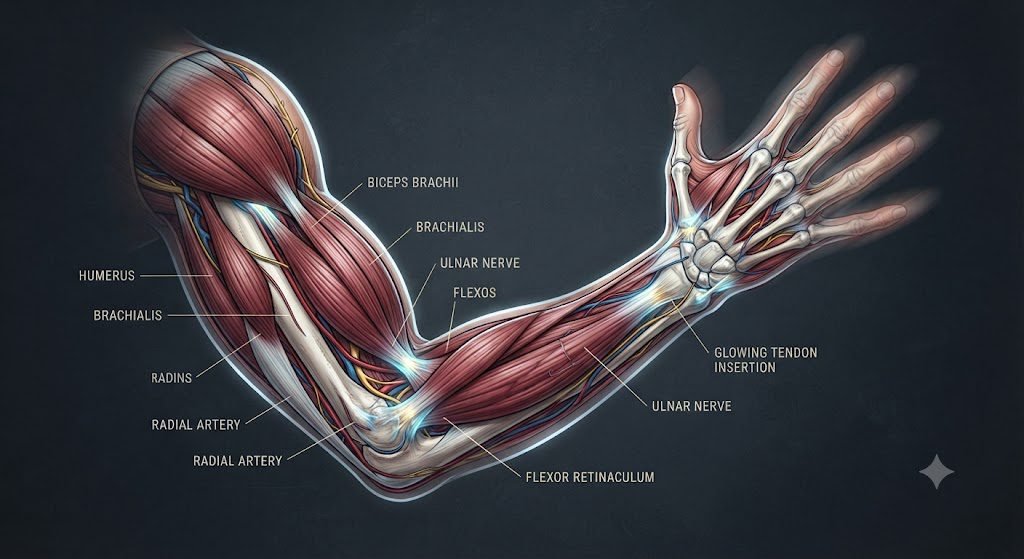
An anatomical cutaway of a human arm in motion showing striated muscle fibers, glowing tendon insertions, and the white bone structure beneath. Tested in Gemini.
Anatomical cutaway illustration of a human arm during motion, detailed striated muscle fibers, glowing biomechanical tendon insertions, stark white bone structure underneath, dark slate grey background, dynamic motion blur on fingertips, precise medical diagram style, golden ratio composition, subtle edge highlighting.
Try in Gemini copies the prompt first, then opens it. Paste it in the chat box and press send.
How to use this prompt
This Anatomy prompt works in Gemini, best at 4:5. It takes less than a minute.
Copy the prompt
Press the copy button above.
Open Gemini
If the prompt edits a photo, upload one clear, front-facing photo first.
Paste and send
Paste in the chat box (Ctrl+V, or long-press on a phone) and send.
Not perfect?
Change a few words and try again, or use a follow-up reply from this page.
Behind the prompt
Using 'striated muscle fibers' acts as an essential texture modifier, prompting the AI to generate fine parallel striations rather than smooth, featureless organic shapes. Midjourney and similar models interpret anatomical cutaways effectively, but they tend to blur the boundary between skeletal bone and surrounding tissue without explicit structural prompts. To separate the anatomical layers more distinctly, change 'striated muscle fibers' to 'color-coded anatomical muscle groups' and include 'flat vector shading'. This tweak eliminates organic textures in favor of an abstract, color-segmented instructional aesthetic ideal for biomechanical analysis.
Generation details
Fix it fast
Quick moves when the first result is not right.
If the layers blend at the edges, replace 'striated muscle fibers' with 'color-coded anatomical muscle groups, flat vector shading' and rerun.
Apply the same cutaway style to a leg mid-stride for a matching lower-body diagram.
Keep the same arm, but separate the muscle and bone layers with clearer edges.
Questions about this prompt
Do I need a reference image?
No. This medical diagram is generated from text alone.
Why do the bone and tissue layers blur together?
Change 'striated muscle fibers' to 'color-coded anatomical muscle groups' with flat vector shading, as the page tip suggests, for clean separation.
Can I show the arm at rest instead?
Yes. Drop the motion blur line and describe a still, extended arm for a calmer diagram.