Transparent Bone and Muscle Layering
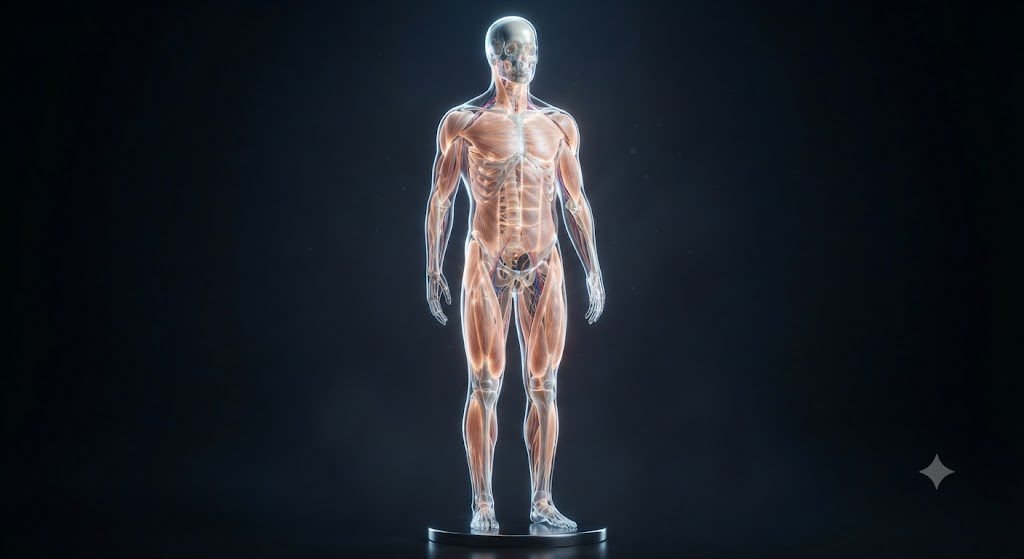
A full-body glass mannequin showing the human skeleton with glowing translucent muscle fibers layered beneath the skin. Tested in Gemini.
A full-body glass mannequin demonstrating the human skeletal structure, with glowing translucent muscle fibers visible underneath translucent dermal layers. Set against a clean dark studio background with rim lighting, soft subsurface scattering on organic tissue, hyper-detailed anatomical breakdown style, subtle color-coded pathways.
Try in Gemini copies the prompt first, then opens it. Paste it in the chat box and press send.
How to use this prompt
This Anatomy prompt works in Gemini, best at 2:3. It takes less than a minute.
Copy the prompt
Press the copy button above.
Open Gemini
If the prompt edits a photo, upload one clear, front-facing photo first.
Paste and send
Paste in the chat box (Ctrl+V, or long-press on a phone) and send.
Not perfect?
Change a few words and try again, or use a follow-up reply from this page.
Behind the prompt
The inclusion of 'subsurface scattering' signals diffusion of light through semi-translucent materials, creating believable visual depth between skeletal elements and soft tissue. Generators like Stable Diffusion or Flux often struggle with nested transparency, sometimes merging internal bones directly into external skin layers instead of maintaining distinct depth planes. A practical fix to resolve muddy transparency is adding 'cross-sectional cutaway view' to your prompt, which instructs the diffusion process to slice open the form cleanly rather than rendering overlapping transparent materials.
Generation details
Fix it fast
Quick moves when the first result is not right.
If the transparent layers turn muddy, add 'cross-sectional cutaway view' and rerun so each layer reads separately.
Limit the figure to the torso only for a larger, clearer view of the layered systems.
Keep the same figure, but separate the bone and muscle layers so they do not blend.
Questions about this prompt
Do I need a reference image?
No. This anatomical breakdown is generated from text alone.
Why do the bones merge into the skin layer?
Nested transparency is hard for models. Add 'cross-sectional cutaway view', as the page tip suggests, to slice the form cleanly.
Can I color-code more systems?
Yes. Ask for nerves in yellow or lymph in green alongside the muscle pathways.