✦ Free AI Image Prompts

Anatomy

Anatomy style prompts β€” ready to use.

26+
Prompts
0
AI Tools
Free
Always

Anatomy Prompts

26 prompts
Glowing Neural Network Brain Map
General

Glowing Neural Network Brain Map

Cross-section of a human brain showing intricate neural pathways, bioluminescent synapsis firing in vivid cyan and magenta, detailed cerebral cortex texture, volumetric glowing axon fibers, dark obsidian background, macro anatomical photograph style, clear depth of field, medical illustration aesthetic, translucent glass-like brain tissue.
πŸ’‘ Expert Insight: The phrase 'volumetric glowing axon fibers' acts as a primary depth anchor, forcing the model to calculate subsurface scattering and layered lighting rather than rendering a flat 2D diagram. Diffusion models generally treat medical visual styles with high anatomical precision, but they often struggle to balance soft bioluminescence with sharp cellular details, sometimes blowing out high-contrast regions. To soften the intensity and achieve a cleaner diagnostic aesthetic, swap 'bioluminescent synapsis' for 'matte pastel pathway indicators' and add 'soft studio ring light'. This shifts the visual balance from dramatic cybernetic fantasy to an elegant clinical textbook diagram.
Gemini
Cutaway Musculoskeletal Arm Mechanics
General

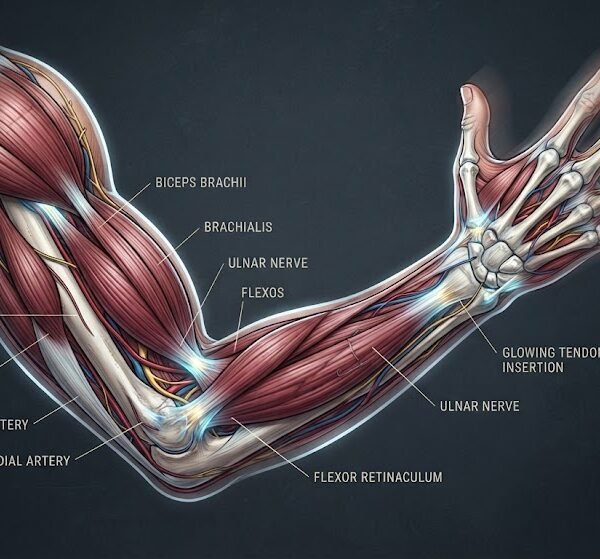
Cutaway Musculoskeletal Arm Mechanics

Anatomical cutaway illustration of a human arm during motion, detailed striated muscle fibers, glowing biomechanical tendon insertions, stark white bone structure underneath, dark slate grey background, dynamic motion blur on fingertips, precise medical diagram style, golden ratio composition, subtle edge highlighting.
πŸ’‘ Expert Insight: Using 'striated muscle fibers' acts as an essential texture modifier, prompting the AI to generate fine parallel striations rather than smooth, featureless organic shapes. Midjourney and similar models interpret anatomical cutaways effectively, but they tend to blur the boundary between skeletal bone and surrounding tissue without explicit structural prompts. To separate the anatomical layers more distinctly, change 'striated muscle fibers' to 'color-coded anatomical muscle groups' and include 'flat vector shading'. This tweak eliminates organic textures in favor of an abstract, color-segmented instructional aesthetic ideal for biomechanical analysis.
Gemini
Synaptic Transmission Neurochemistry
General

Synaptic Transmission Neurochemistry

Close-up visualization of a synaptic cleft, presynaptic terminal releasing neurotransmitter vesicles, postsynaptic receptors glowing upon activation, deep indigo surrounding fluid, vibrant electric blue chemical signals, high-detail cellular membrane texture, volumetric light beams penetrating microscopic space, clinical render.
πŸ’‘ Expert Insight: The phrase 'presynaptic terminal releasing' establishes a directional narrative, directing the image generator to depict dynamic kinetic motion between two distinct anatomical boundaries. Text-to-image models usually synthesize neurochemical scenes with rich particle effects, but they sometimes blend the pre- and post-synaptic membranes together into a single ambiguous mass. To enforce strict spatial segregation and emphasize structural geometry, replace 'vibrant electric blue chemical signals' with 'stark monochrome structural line art' and append 'orthographic cross-section view'. This refines the composition into an untextured schematic that emphasizes spatial boundaries over cinematic lighting effects.
Gemini
Bioluminescent Human Muscular and Skeletal Diagram
General

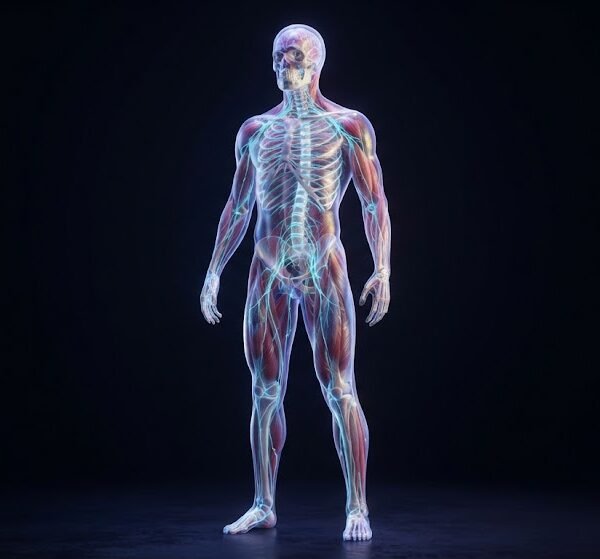
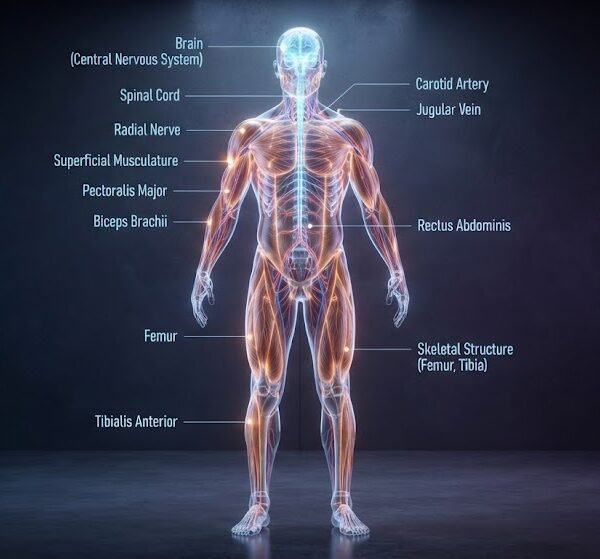
Bioluminescent Human Muscular and Skeletal Diagram

Full body human anatomical figure presented in a dark void, featuring semi-transparent iridescent skin revealing glowing cyan nerve pathways and crimson muscular structures. Intricate skeletal alignment displayed from head to toe, illuminated by volumetric rim lighting and subtle subsurface scattering, capturing precise biological proportions and dynamic standing posture.
πŸ’‘ Expert Insight: Using the phrase subsurface scattering is crucial here because it instructs diffusion models to simulate light penetrating translucent dermal layers rather than rendering solid plastic surfaces. Generative models like Midjourney or Flux often default to overly smooth, synthetic textures when handling full-body anatomical displays, sometimes obscuring fine skeletal details under dense glow effects. If the internal systems appear too washed out by illumination, lower the luminous intensity by swapping glowing cyan for faint arterial luminescence or adjust the aspect ratio to give the full-body silhouette more vertical breathing room.
Gemini
Renaissance Ink and Parchment Anatomical Sketch
General

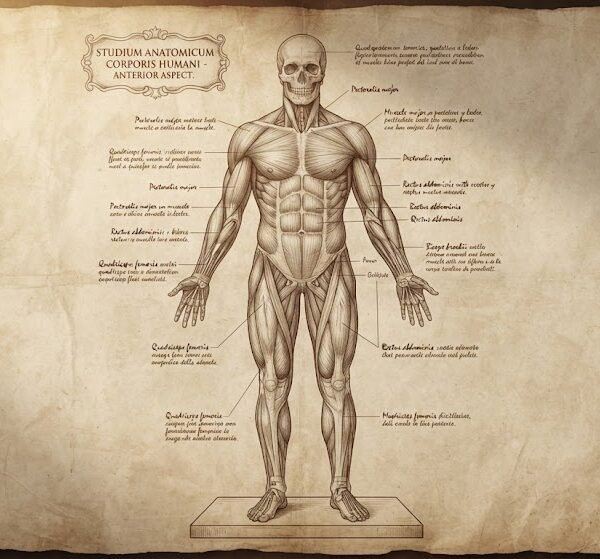
Renaissance Ink and Parchment Anatomical Sketch

Full body human anatomical study rendered in traditional sepia ink on aged parchment paper, showing exposed anterior muscular groups and precise bone structures. Cross-hatched shading, handwritten Renaissance annotations along the margins, delicate quill line art, balanced axial composition, and warm directional lighting highlighting full anatomical accuracy from head to feet.
πŸ’‘ Expert Insight: The modifier cross-hatched shading plays a critical role in anchoring the aesthetic, forcing the latent space to pull from classical botanical and anatomical printmaking techniques instead of modern digital vector art. Diffusion models typically handle historical draft styles well, though they frequently hallucinate illegible text fragments along the borders to mimic authentic manuscript annotations. To transform this classic academic sketch into a modern architectural schematic, replace aged parchment paper with blueprint negative paper and specify white technical linework against a deep indigo background for immediate visual contrast.
Gemini
Futuristic Holographic Full Body Anatomical Scan
General

Futuristic Holographic Full Body Anatomical Scan

Transparent full body human holographic schematic floating in a dark laboratory space, displaying glowing cyan vascular networks, skeletal frame, and internal organ systems. Clean vector grid lines surrounding the figure, soft volumetric light rays, chromatic aberration along edge boundaries, balanced standing stance displaying complete head-to-toe structural alignment.
πŸ’‘ Expert Insight: Incorporating chromatic aberration adds realistic optical imperfection, preventing the holographic projections from appearing overly flat or digital. Modern image generators excel at neon line art, but they often struggle with spatial depth when rendering nested anatomical layers, sometimes blending background ribs with foreground abdominal muscles into a confusing visual tangle. A solid concrete fix to improve structural clarity is to introduce a strict color hierarchy, such as explicitly assigning blue tones exclusively to the skeletal system and amber tones to the circulatory system, forcing clearer semantic separation across layers.
Gemini
Translucent Glass Full Body Anatomical Model
General

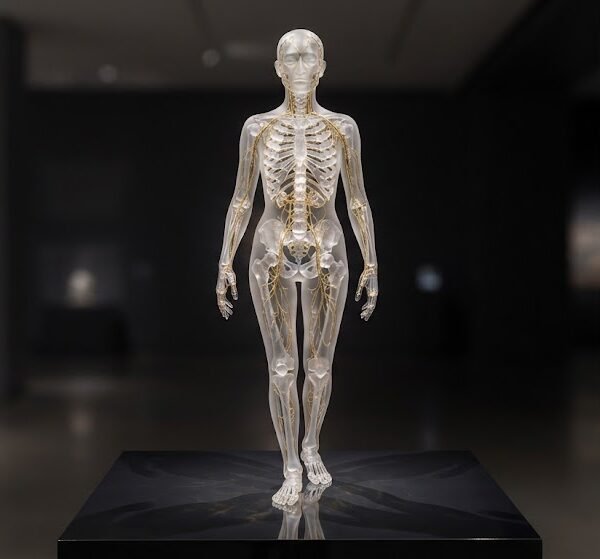
Translucent Glass Full Body Anatomical Model

Full body human figure crafted from frosted blown glass and polished resin, detailing crystalline internal skeletal structures and delicate golden wire vascular systems. Soft ambient studio lighting creating complex refraction and ray-traced shadows, standing pose on a dark reflective pedestal, capturing complete anatomical proportion with pristine spatial clarity.
πŸ’‘ Expert Insight: Specifying complex refraction guides the renderer to calculate physical light behavior through varying material densities, elevating the visual realism of glass and resin elements. When generating full-figure sculptural studies, AI models frequently distort extremities like toes or fingers, or fail to maintain logical connectivity between internal structural features. To shift this render from an abstract gallery piece into an industrial design mock-up, replace frosted blown glass with matte grey polyurethane resin to eliminate internal transparency and focus strictly on surface muscular contour and light falloff.
Gemini
Cinematic Cross Section Muscular Anatomy Render
General

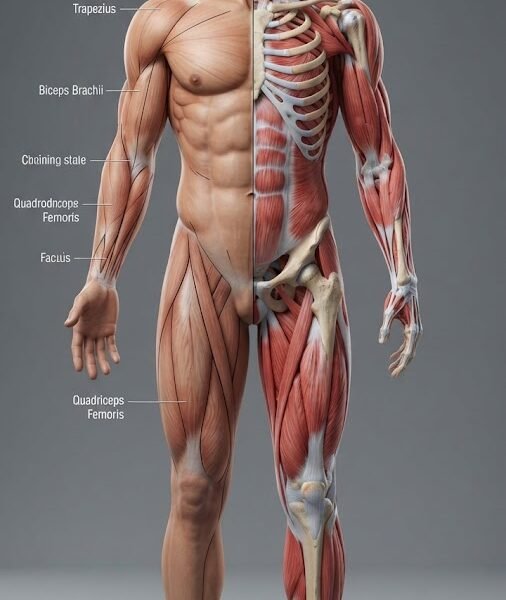
Cinematic Cross Section Muscular Anatomy Render

Full body athletic human figure in a neutral anatomical position, showcasing a lateral cross-section split between outer skin tone and vivid inner muscular and skeletal systems. Soft neutral studio key lighting, subtle depth of field, high contrast textures, precise muscular fibers, clear tendon insertion points, balanced vertical composition against a muted grey background.
πŸ’‘ Expert Insight: The key phrase neutral anatomical position grounds the prompt in standard medical illustration standards, preventing the AI from generating dynamic, twisted poses that hide critical muscular groups. Generative models tend to over-render muscular density in full-body shots, creating hyper-shredded figures that lose natural anatomical proportions. If you notice the split-face or split-body transition looks too jagged or erratic, introduce the term clean vertical bi-section line to force a sharper, more deliberate separation between the exposed interior anatomy and the natural outer dermis.
Gemini
Futuristic Cybernetic Muscular Anatomy Display
General

Futuristic Cybernetic Muscular Anatomy Display

Full body anatomy illustration of an athletic human figure rendered in semi-transparent bioluminescent glass, revealing intricate superficial musculature, vascular networks, and a glowing central nervous system. Rendered against a dark minimalist studio background with soft rim lighting emphasizing muscle striations and bone density. Clean medical textbook aesthetic combined with futuristic holographic overlays showing anatomical labels.
πŸ’‘ Expert Insight: The phrase "bioluminescent glass" serves as a critical rendering anchor here, forcing the diffusion model to balance subsurface scattering with internal light emission rather than treating the skin as opaque tissue. Diffusion architectures like Midjourney often struggle with complex nested internal structures, sometimes merging vascular lines into muscular striations. To maintain distinct visual layers, the model relies heavily on the rim lighting cue to separate depth planes. If the internal organs appear overly cluttered or distorted, swap the holographic overlay description for a volumetric wireframe aesthetic, which simplifies the structural geometry while preserving the transparent anatomical depth.
Gemini
Classical Renaissance Chalk Anatomical Figure Study
General

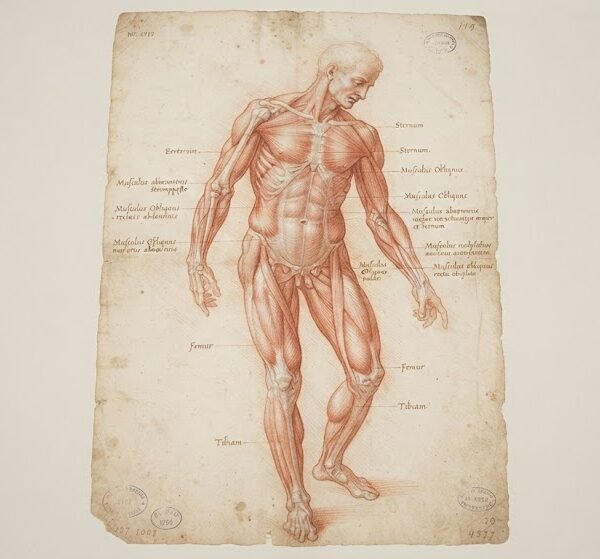
Classical Renaissance Chalk Anatomical Figure Study

Full body anatomical study of a standing male figure in dynamic contrapposto pose, executed in red and white chalk on aged parchment paper. Detailed cross-section rendering of the superficial skeletal system alongside deep muscular layers of the torso and limbs. Fine hatching, realistic shading, subtle smudging, dynamic anatomical proportions, authentic historical medical sketch style, ambient soft museum lighting.
πŸ’‘ Expert Insight: Specifying "dynamic contrapposto pose" is essential for classical anatomical accuracy because it forces the model to calculate realistic weight distribution, shifting muscle tension across the pelvic girdle and calves naturally. Text-to-image models generally excel at historical chalk media, though they frequently over-render anatomical details into chaotic line work. The parchment texture acts as a dampener, softening harsh generated contours. If you notice the skeletal and muscular layers blending together confusingly, isolate the figure by specifying a dual-panel split canvas layout, placing the pure skeletal framework on the left and muscle groups on the right.
Gemini
Ethereal Translucent Medical Visualisation of Musculature
General

Ethereal Translucent Medical Visualisation of Musculature

Full body anatomical visualization of a female dancer captured mid-motion, featured in an translucent x-ray style. Delicate glowing skeleton, hyper-detailed tendinous insertions, and layered muscle bellies suspended in a dark volumetric space. High contrast studio lighting, deep shadows, crisp edge definition, precise skeletal proportions, clean scientific aesthetics with subtle motion blur on extremities.
πŸ’‘ Expert Insight: Using "tendinous insertions" directs the latent space toward specific tendinous junction geometry rather than generic smooth limbs, giving the muscular system plausible structural anchors. Generative engines like Stable Diffusion often struggle with full-body dynamic motion, frequently distorting long bones like the femur or radius when combined with transparency. The dark volumetric background helps isolate these translucent layers by raising foreground contrast. To transform this from a pure medical visualization into a dark fantasy asset, try replacing the volumetric studio space with an back-lit obsidian pedestal and warm directional key light.
Gemini
Industrial Steampunk Mechanical Human Body Cross-Section
General

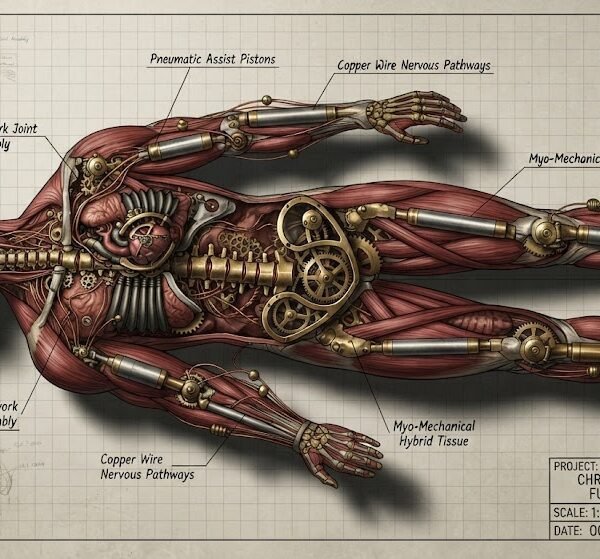
Industrial Steampunk Mechanical Human Body Cross-Section

Full body anatomical cross-section of a human figure combining organic muscle tissue with intricate brass clockwork mechanisms, exposed spinal column, pneumatic pistons, and delicate copper wire nervous system. Vintage industrial blueprint backdrop, harsh directional side lighting casting deep shadows across mechanical joints, detailed mechanical textures, matte finish, scientific illustration aesthetic.
πŸ’‘ Expert Insight: Incorporating "pneumatic pistons" forces the generator to integrate rigid mechanical joints into fluid biological flex points like knees and elbows, creating a believably functional hybrid structure. Modern image models handle biomechanical styles remarkably well, though they tend to clutter the torso area with redundant gears, obscuring organic muscle flow. The directional side lighting is vital here to carve out depth along the spinal column. For a sleek modern alternative, replace the brass clockwork and blueprint background with matte carbon-fiber actuators and a clean white laboratory backdrop.
Gemini
✨

You've reached the end of the archive.

More prompts coming soon.

Prompt copied!